

Occupational therapy for adults helps people regain, build, or maintain practical skills for daily living, working, and self-care after injury, illness, surgery, or as they age. It focuses on what matters most: cooking, dressing, returning to work, or moving safely at home. For adults in Dubai, services like Bridges Care Speech Therapy Center offer structured support connecting physical recovery with real-world independence.
Understanding Comparison & Therapy Differences-and-occupational-therapy/) matters early. Occupational therapy is not physiotherapy. Physiotherapy concentrates on movement, strength, and joint function. Occupational therapy starts with the activity you want to do and works backward to identify physical, cognitive, or environmental barriers. Both can work together but answer different questions.
What Does an Occupational Therapist Do for Adults?
An occupational therapist evaluates how you perform daily activities, then designs a plan to close the gap between current ability and goals. The process typically includes:
- Assessing self-care tasks like bathing, dressing, grooming, and feeding
- Evaluating home safety and recommending modifications
- Training in adaptive equipment or assistive technology
- Building cognitive strategies for memory, planning, and attention
- Addressing sensory processing differences affecting daily function
- Coaching family members or caregivers on safe support techniques
Treatment shifts based on condition, environment, and priorities. One adult may need handwriting supports after a hand injury. Another may need backward chaining to relearn a morning routine after a stroke.
Why Would an Adult Go to Occupational Therapy?
Adults seek occupational therapy for many reasons. Some recover from neurological events. Others manage long-term conditions eroding independence.
Neurological Conditions
Stroke, Parkinson’s disease, multiple sclerosis, and traumatic brain injury affect motor control, coordination, and cognition. Therapy often includes repetitive task practice, cognitive orientation strategies, and environmental modification. Someone relearning meal preparation after a stroke might practice sequencing steps, using one-handed cutting tools, and organizing the kitchen to reduce confusion.
Physical Injuries and Surgery
After fractures, joint replacements, burns, or spinal cord injuries, adults need help transitioning from medical recovery to functional independence. Therapy may involve adaptive equipment for dressing, modified bathing techniques, and seating assessments to prevent pressure injuries. The goal is restoring the ability to live without constant assistance.
Mental Health and Cognitive Changes
Anxiety, depression, and early dementia affect how adults structure their day, manage responsibilities, and maintain social connections. Occupational therapists use structured activities, routine building, and coping strategies to help adults stay active at home and work. Clinical Psychology may address underlying emotional patterns, while occupational therapy translates those gains into daily function.
Age-Related Decline
Older adults face reduced balance, vision changes, and slower processing. Occupational therapy reduces fall risks through home assessments, recommends grab bars or ramps, and simplifies tasks. In Dubai, therapists often assess bathrooms, kitchen counters, and balcony access as part of the plan.

Occupational Therapy Activities for Adults
Sessions vary. Some activities directly practice daily tasks. Others build underlying skills.
| Activity Type | Example | Purpose |
| Self-care training | Practicing dressing with one hand | Restore independence after stroke or injury |
| Home simulation | Rehearsing meal prep in a mock kitchen | Build sequencing and safety awareness |
| Cognitive exercises | Memory games, planning tasks | Support attention and executive function |
| Sensory integration | Graded exposure to textures or sounds | Reduce sensory overload that blocks participation |
| Adaptive equipment training | Using a reacher, sock aid, or built-up utensils | Compensate for limited range of motion |
| Community reintegration | Planning a bus route or grocery trip | Rebuild confidence outside the home |
Sensory Integration is often associated with children, but adults with sensory processing differences also benefit. An adult overwhelmed in crowded spaces or unable to tolerate certain clothing textures may avoid work events or family gatherings. Gradual exposure and environmental adjustments reduce that avoidance.
Occupational Therapy vs Physiotherapy
| Factor | Occupational Therapy | Physiotherapy |
| Primary focus | Daily activities and participation | Movement, strength, and mobility |
| Starting point | The task you want to do | The physical impairment |
| Common tools | Adaptive equipment, task modification, cognitive strategies | Exercise, manual therapy, gait training |
| Typical goals | Independent dressing, safe cooking, work readiness | Improved range of motion, reduced pain, better balance |
| Setting | Home, clinic, workplace, community | Clinic, gym, hospital |
Both are part of a comprehensive rehabilitation plan. Many adults in Dubai see both professionals after a stroke or major surgery. The physiotherapist rebuilds physical capacity. The occupational therapist applies that capacity to real life.
How Occupational Therapy Works in Practice
The process begins with an assessment. The therapist watches how you perform tasks, asks about your routine, and identifies breakdowns. Treatment might include:
- Modifying the task: breaking it into smaller steps or changing the method
- Modifying the environment: adjusting lighting, reducing clutter, adding supports
- Building skills: practicing underlying motor, cognitive, or sensory components
- Introducing equipment: recommending tools that compensate for lost function
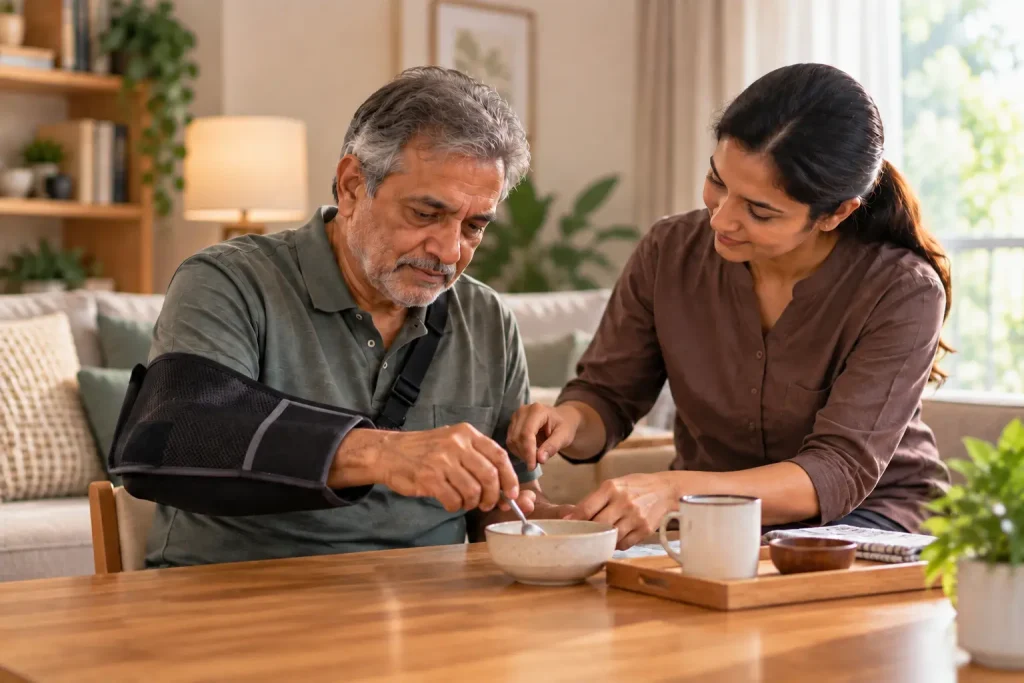
For Feeding & Daily Independence, an adult with Parkinson’s disease might practice tremor management while eating, use weighted utensils, and adjust seating to improve swallowing safety. The therapist trains the person to use tools consistently and troubleshoot when they fail.
Common Mistakes Adults Make
Many adults delay seeking occupational therapy, assuming it is only for children or severe disabilities. That delay makes habits harder to change. Another mistake is focusing only on physical impairment while ignoring the environment. A person with arthritis may struggle less with joint mobility than with a kitchen layout forcing awkward reaching. Best outcomes come from addressing both.
Some adults expect passive treatment. It is not. Progress depends on practicing strategies between sessions, modifying routines, and accepting some tasks may need to be done differently.
Occupational Therapy in Dubai
Adults in Dubai access occupational therapy through hospitals, rehabilitation centers, and private clinics. Bridges Care Dubai Speech Therapy Center supports adults alongside its speech and language services. When choosing a therapist, look for someone who assesses your actual home or work environment, not just physical abilities. Ask about experience with your condition and whether they coordinate with physiotherapists or clinical psychologists.
Dubai’s climate and built environment matter. Heat affects energy levels and activity tolerance. High-rise living means elevator access, door widths, and bathroom layouts influence what is realistic. A good therapist accounts for these local factors rather than applying a generic plan.
What to Ask Before Starting
- What is your experience with adults who have my condition?
- Will you assess my home or workplace, or only the clinic setting?
- How do you coordinate with my other healthcare providers?
- What should I practice between sessions?
- How will we measure progress?
These questions help you find a therapist who treats the whole context of your life, not just the diagnosis.
Frequently Asked Questions
1. What does an occupational therapist do for adults?
An occupational therapist helps adults perform daily activities that matter to them, including self-care, work tasks, home management, and community participation. They assess physical, cognitive, and environmental barriers, then design interventions using task modification, adaptive equipment, skill building, and environmental changes.This type of adult therapy focuses on practical goals that improve independence at home, work, and in the community.
2. Why would an adult go to occupational therapy?
Occupational therapy for adults can help people who experience difficulty with everyday activities due to various health conditions. Adults seek occupational therapy after strokes, brain injuries, joint surgeries, burns, or spinal cord injuries. They also seek help for chronic conditions like arthritis, Parkinson’s disease, multiple sclerosis, mental health challenges, and age-related decline. The common thread is difficulty performing everyday activities independently.
3. Why doesn’t therapy work for everyone?
Therapy may not work when goals are unclear, when the person cannot practice between sessions, or when the environment does not support change. Mismatched therapist experience, untreated underlying conditions, and unrealistic expectations also reduce outcomes. Progress requires active participation and a plan fitting the person’s actual daily life.
4. What are some good occupational therapy activities for adults?
Useful activities include practicing dressing with adaptive equipment, rehearsing meal preparation in a simulated kitchen, memory and planning exercises, sensory integration tasks, and community outings like navigating a grocery store. The best activities tie directly to the person’s real goals.
If daily tasks feel harder than they should, a consultation with an occupational therapist can clarify what is changing and what can be done. Book a consultation to discuss your specific challenges and build a practical plan for independence.