
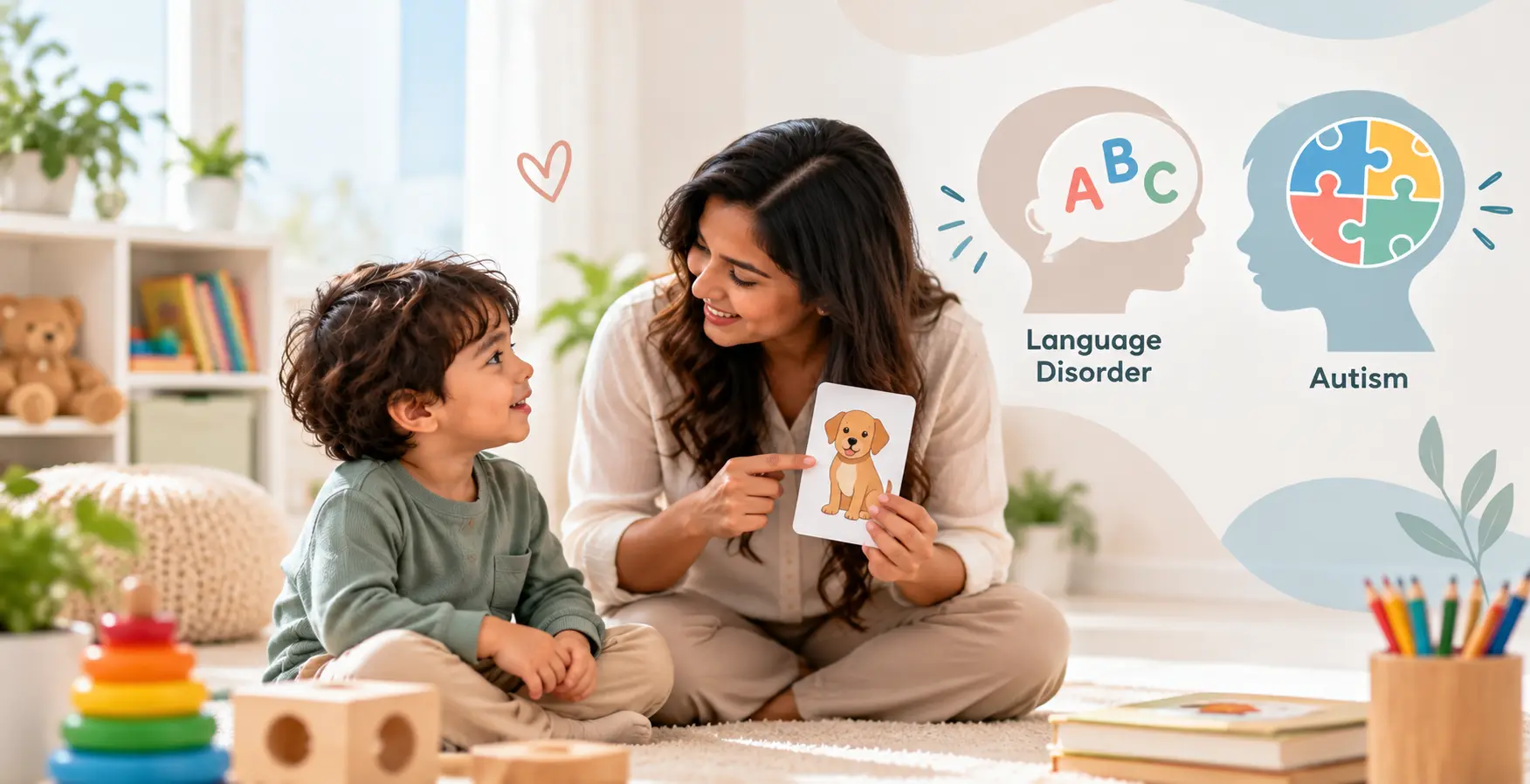
No, a language disorder is not autism. They are separate neurodevelopmental conditions that can look similar and sometimes occur together, but they have different core features, diagnostic criteria, and implications for support. If you are searching this question, you are likely trying to make sense of a child’s communication struggles, and the distinction matters more than most people realise. For a deeper look into how neurodevelopmental profiles differ from mental health concerns, you can also explore our article on Is Autism a Psychological Disorder? Clear Facts & Support.
BridgescareDubai works with families navigating exactly this question, and the first thing to understand is that language disorder and autism are not interchangeable labels. A child with a language disorder wants to connect socially but struggles with the mechanics of words. An autistic child faces broader challenges that go beyond language itself.
The Core Difference in Plain Terms
Developmental Language Disorder (DLD) is a persistent difficulty understanding or using spoken language across all languages a person speaks. It affects vocabulary, grammar, sentence structure, following instructions, and conversation skills. It is not caused by hearing loss, intellectual disability, or another medical condition. Around 7% of children have DLD.
Autism Spectrum Disorder (ASD) is defined by two core traits: challenges with social communication and interaction, plus restricted or repetitive behaviors and interests. Around 2% of children are autistic. The social communication piece can include language difficulties, but it also extends to reading body language, facial expressions, and understanding what others are thinking or feeling.
The clearest distinction is this: repetitive behaviors such as hand flapping, rocking, head banging, intense fixations on specific objects or themes, and difficulty with transitions are specific to autism. They are not part of DLD.

When Both Conditions Co-Occur
A child can absolutely have both. The clinical term is Language Disorder Associated with Autism. Research published in Brain Sciences found that within a group of autistic children, there is a subgroup whose language difficulties mirror those seen in DLD. Both groups scored lower than typically developing children on language measures, indicating a shared language pathology, but the autism group also showed the broader social and behavioral features.
This dual diagnosis matters because language needs can get overlooked when everything is attributed to autism. Using the label Language Disorder Associated with Autism makes clear that the child needs ongoing, targeted language support, not just autism-specific interventions.
| Feature | Language Disorder (DLD) | Autism Spectrum Disorder (ASD) |
| Core difficulty | Understanding and using spoken language | Social communication plus restricted/repetitive behaviors |
| Social motivation | Wants to connect, struggles with words | May struggle with the social meaning behind words |
| Repetitive behaviors | Not present | Present (flapping, rocking, fixations, difficulty with transitions) |
| Body language and facial expression | Typically understood | Often difficult to interpret |
| Prevalence | Around 7% of children | Around 2% of children |
| Co-occurring medical conditions | Often none | Seizures, digestive issues, or sleep disorders in some children |
What Language Disorder Looks Like in Real Life
A child with DLD might take instructions literally, struggle to understand sayings like “this room is a pigsty,” have trouble staying on topic in conversation, include too much or too little information when speaking, or find it hard to remember what was just said. These are language mechanics problems, not social disinterest.
An autistic child might face those same language challenges, but also struggle to read a frown versus a smile, miss the unspoken rules of play, or become intensely distressed when a routine changes. The difference is the presence of those broader social and behavioral patterns.
Why DLD Often Goes Unrecognised
Children with DLD frequently have no other obvious medical problems. They may not see a doctor for seizures, sleep issues, or digestive concerns the way some autistic children do. As a result, DLD can fly under the radar. A child who is simply “quiet” or “a late talker” may actually have a developmental language disorder that needs structured support. To learn more about early milestones and when to seek guidance, families can read our detailed guide on Is a 2-Year-Old Considered a Late Talker?.
This is where the question Is Delayed Speech a Sign of Autism? becomes important. Delayed speech can be a sign of autism, but it can also be a sign of DLD, a hearing issue, or simply a temporary developmental lag. The presence of speech delay alone does not point to autism. What points to autism is speech delay combined with reduced social engagement, repetitive behaviors, and difficulty reading nonverbal cues.
Practical Support Strategies
If a child has Language Disorder Associated with Autism, these strategies help:
- Call the child by name first before giving an instruction. Words like “everyone” may not register as including them.
- Wait about ten seconds after speaking before repeating. Processing time is often longer.
- Break instructions into small, single steps.
- Use visuals alongside spoken language: pictures, written words, photos, objects.
- Teach new vocabulary through multiple senses: touch, sound, smell, and sight together.
- Colour-code parts of words to help with sentence building.
- Praise the child when they ask for clarification rather than pretending to understand.
In Dubai, families can access speech therapy through private clinics and some school-based services. Speech therapy for autism and for DLD often looks similar in the language-building techniques used, but autism support typically also addresses social pragmatics and behavioral patterns. A qualified Therapist can assess whether a child’s difficulties are primarily linguistic, primarily social-communicative, or both. For structured support with behavior and daily adaptive skills, families often benefit from specialized ABA Therapy Services, while speech and language therapy targets the linguistic piece.
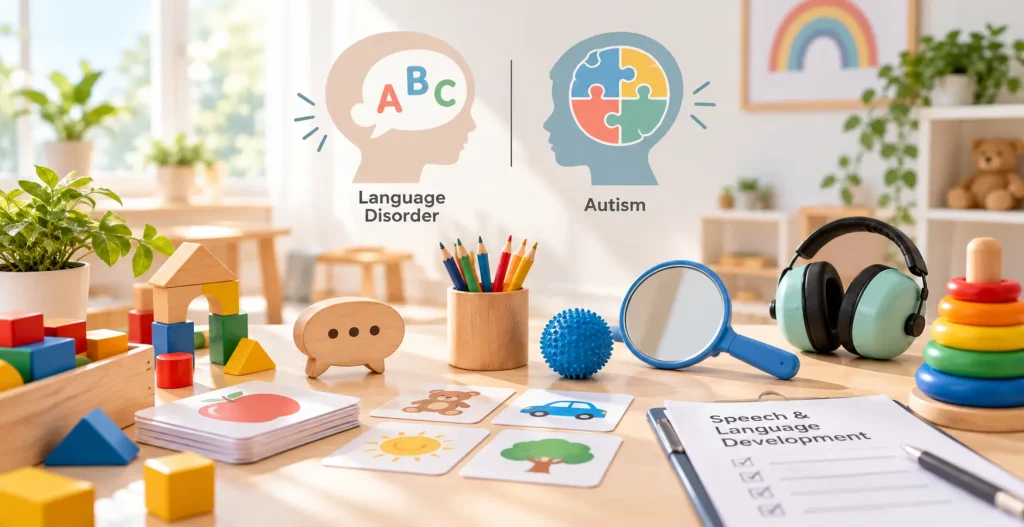
Role Models and Realistic Expectations
Language disorder and autism are not ceilings. Greta Thunberg, George Webster, and Will.i.am are among the public figures who have spoken openly about autism or language differences. What changes outcomes is early identification, the right mix of support, and adults who understand the distinction between struggling with words and struggling with social connection.
If you are unsure which label fits your child, a comprehensive assessment by a speech-language pathologist and a developmental specialist is the most reliable next step. Book a consultation with a qualified professional who can assess both language and social communication, because getting the distinction right changes the entire support plan. Families looking for structured diagnostic insight can also explore Clinical Psychology Services to better understand emotional, behavioral, and developmental profiles.
FAQ
1. Is there a cure for autism spectrum disorder?
No. Autism is a lifelong neurodevelopmental difference, not a disease. Support focuses on building skills, reducing barriers, and improving quality of life, not on “curing” the person.
2. What is a speech delay in autism?
A speech delay means a child is not meeting typical language milestones for their age. In autism, this delay often sits alongside reduced use of gestures, limited eye contact, and less interest in social back-and-forth, which helps distinguish it from a pure language delay.
3. Is living with autism hard?
It can be, particularly when sensory environments are overwhelming, communication is effortful, or routines are disrupted. But difficulty varies widely across the spectrum, and with the right supports many autistic people lead fulfilling, independent lives.
4. Can an autistic child speak after 10 years?
Yes. Some autistic children who are minimally verbal in early childhood develop spoken language later, including in adolescence. Progress depends on individual factors, but language development can continue well beyond early childhood.