How to Improve Speech Delay at Home: Practical Tips for Parents
A speech delay means a child is following the typical path of language development, just more slowly than expected. The good news is that most children improve significantly when parents use simple, consistent strategies at home, ideally alongside guidance from a qualified professional. For families in Dubai, services like Bridgescare dubai offer structured support when home strategies alone are not enough.
What Helps Right Now: A Practical Starting Point
Before diving into techniques, it helps to know what actually moves the needle. The strategies below work because they turn everyday moments into language-learning opportunities without making a child feel pressured or tested.
| Strategy | What It Looks Like | Why It Works |
| Self-talk | Narrate what you are doing: “I am cutting the apple” | Connects words to real actions in real time |
| Parallel talk | Describe what the child is doing: “You are stacking blocks” | Labels the child’s own focus and interest |
| Expansion | Child says “ball,” you say “Yes, big red ball” | Models slightly richer grammar without correcting |
| Wait time | Pause several seconds after asking or offering | Gives the child time to process and respond |
Recognise What Typical Development Looks Like
By around 24 months, most children use about 50 or more words daily, combine small words into simple requests like “more milk,” and can follow simple instructions. By age three, many children speak in two- and three-word phrases, use over 200 words, say their own name, and use simple pronouns like “I,” “my,” and “me.” Parents and caregivers should understand most of what a three-year-old says.
If a child is not meeting these benchmarks, it does not automatically mean something is wrong. But it does mean a conversation with a paediatrician or a speech-language pathologist is worth having sooner rather than later.
Home Strategies That Build Language Naturally
Read With Your Child Every Day
Children learn language through interaction with people, not through screens. Reading picture books with short, engaging stories gives a child repeated exposure to how words sound and how sentences flow. Point to pictures, name objects, and pause to let the child react. Reading before naptime and bedtime works well because the routine itself supports attention.
Use Self-Talk and Parallel Talk
Self-talk means putting words to your own actions. While cooking, say “I am washing the rice” or “I am stirring the soup.” Parallel talk means putting words to the child’s actions. If the child is playing with blocks, point and say “blocks” or “you are building a tower.” Repetition is useful here. Children learn through hearing the same simple words and phrases in meaningful contexts.
Build On What Your Child Says
When a child attempts a word, respond by expanding it slightly. If the child says “car,” respond with “Yes, blue car” or “fast car.” This validates the attempt and models the next step in language development without demanding the child repeat anything. The goal is exposure, not performance.
Offer Choices and Wait
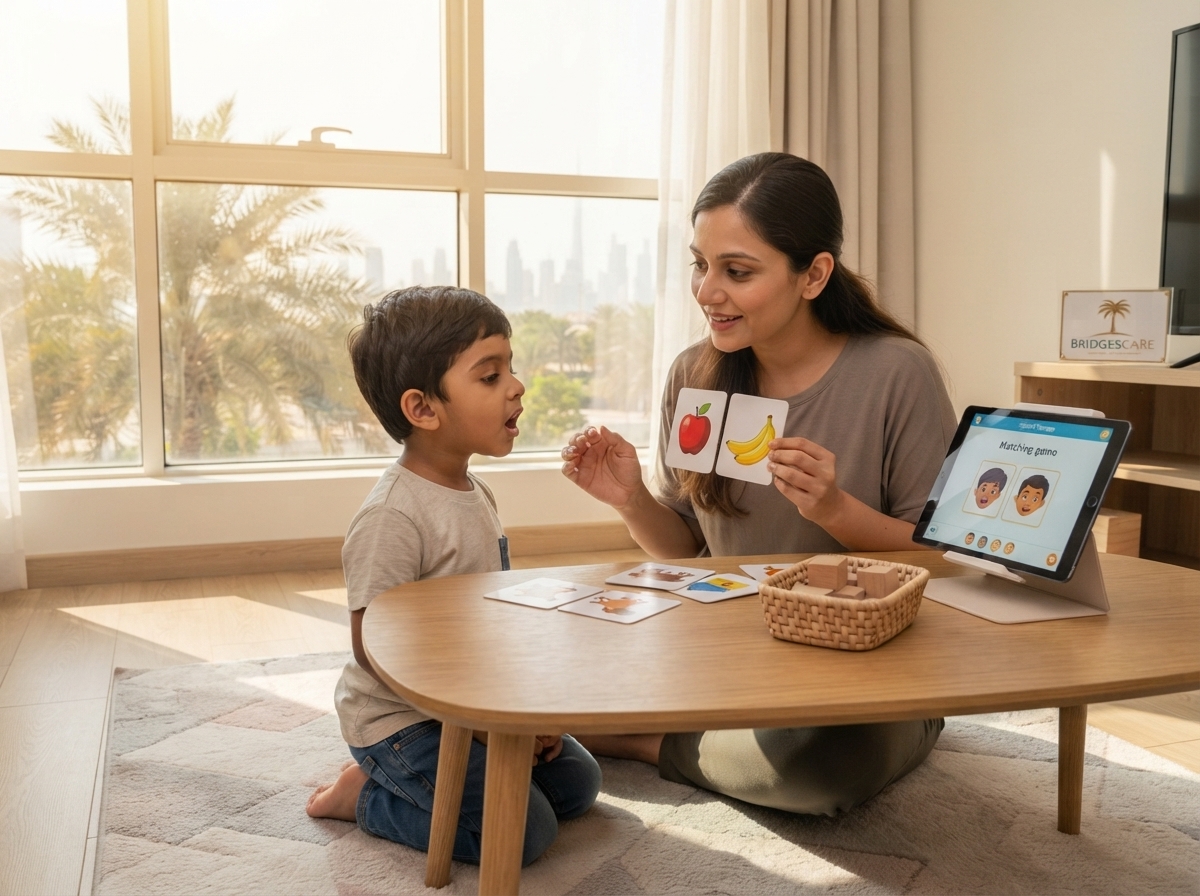
Hold up two items, name each one clearly, and wait. For example, hold an apple and a banana and say “apple or banana?” Give the child several seconds to point, gesture, or vocalise before handing over the chosen item. The pause is important. Many parents fill the silence too quickly, which removes the child’s opportunity to initiate communication.
Sing Simple, Repetitive Songs
Songs with actions and repetition help connect words to movement and meaning. Familiar nursery rhymes and action songs work well because the predictable structure lets a child join in at their own level, even if only through gestures at first.
When Home Strategies Are Not Enough
Speech delay in kids can have many underlying causes, and not all of them respond to home practice alone. Hearing difficulties, oral-motor issues, and developmental conditions can all affect speech. A formal evaluation helps identify what is actually going on.
Bridgescare provides Speech Therapy support that can assess a child’s specific needs and build a targeted plan. For many families, a combination of professional sessions and consistent home practice produces the best results. Speech Therapy at Home is also an option for children who respond better in familiar surroundings, and Home Care Therapy can support families who find clinic visits difficult to manage.
What Parents in Dubai Should Consider
Dubai has a well-developed network of paediatric and therapy services, but navigating them can feel overwhelming. A speech therapy centre in Dubai typically offers multidisciplinary assessments, which can be helpful because speech delay sometimes overlaps with other developmental concerns. Some children benefit from ABA Therapy when speech delay occurs alongside behavioural or social communication challenges.
The climate and lifestyle in Dubai also shape daily routines. Indoor play spaces, mall-based activities, and home-based routines are common, especially during hotter months. These settings still offer rich language opportunities. Narrating a trip to the supermarket, describing what is happening at the park, or talking through a simple cooking activity at home all count as language-rich interaction.

Common Mistakes to Avoid
- Replacing human interaction with screens. Research consistently shows that young children learn language best from live, responsive people, not from videos or apps alone.
- Asking too many questions. Constant quizzing can make a child withdraw. Balance questions with comments and descriptions.
- Correcting every attempt. If a child says “wabbit,” responding with “Yes, rabbit” is enough. Repeated correction can discourage trying.
- Waiting too long to seek help. Early intervention is well established as the most effective approach for speech and language difficulties.
Simple Exercises to Improve Communication Skills
These can be woven into daily life without setting aside special practice time. Parents looking for structured ideas can explore Simple Exercises to Improve Communication Skills that are easy to implement at home:
- Name objects during routines: “sock,” “spoon,” “water,” “shoes”
- Use gesture alongside words: wave while saying “bye-bye”
- Pause during familiar songs and let the child fill in a word or action
- Follow the child’s lead during play and comment on what they choose
For more structured guidance, parents can look into Speech Delay in Toddlers: What Parents Need to Know About Causes and Treatment and Book consultation with a qualified professional when concerns persist beyond the expected age ranges.
Frequently Asked Questions
Can speech delay be improved?
Yes. Most children with speech delay make meaningful progress with consistent language-rich interaction at home and, where needed, structured support from a speech-language pathologist. Early intervention is associated with better long-term outcomes.
How to remove speech delay?
There is no instant cure, but speech delay can be reduced through daily strategies like self-talk, parallel talk, reading, singing, and expansion. Underlying causes such as hearing issues should be ruled out through a professional assessment.
How do I help my child with a speech delay?
Use everyday routines to model language, offer choices, pause to allow responses, and build on whatever the child says. Avoid pressure and keep interactions playful. Seek a professional evaluation if progress is slow or if the child is not meeting age-based milestones.
At what age do late talkers talk?
Many late talkers catch up by age three or four, especially with supportive input. However, there is no guaranteed age, and children who are not using around 50 words by 24 months or combining words by age three should be evaluated rather than waiting indefinitely.
If your child is not meeting speech milestones, Book consultation with a qualified professional. A proper assessment can identify the reason for the delay and guide the right combination of home strategies and therapy support.