
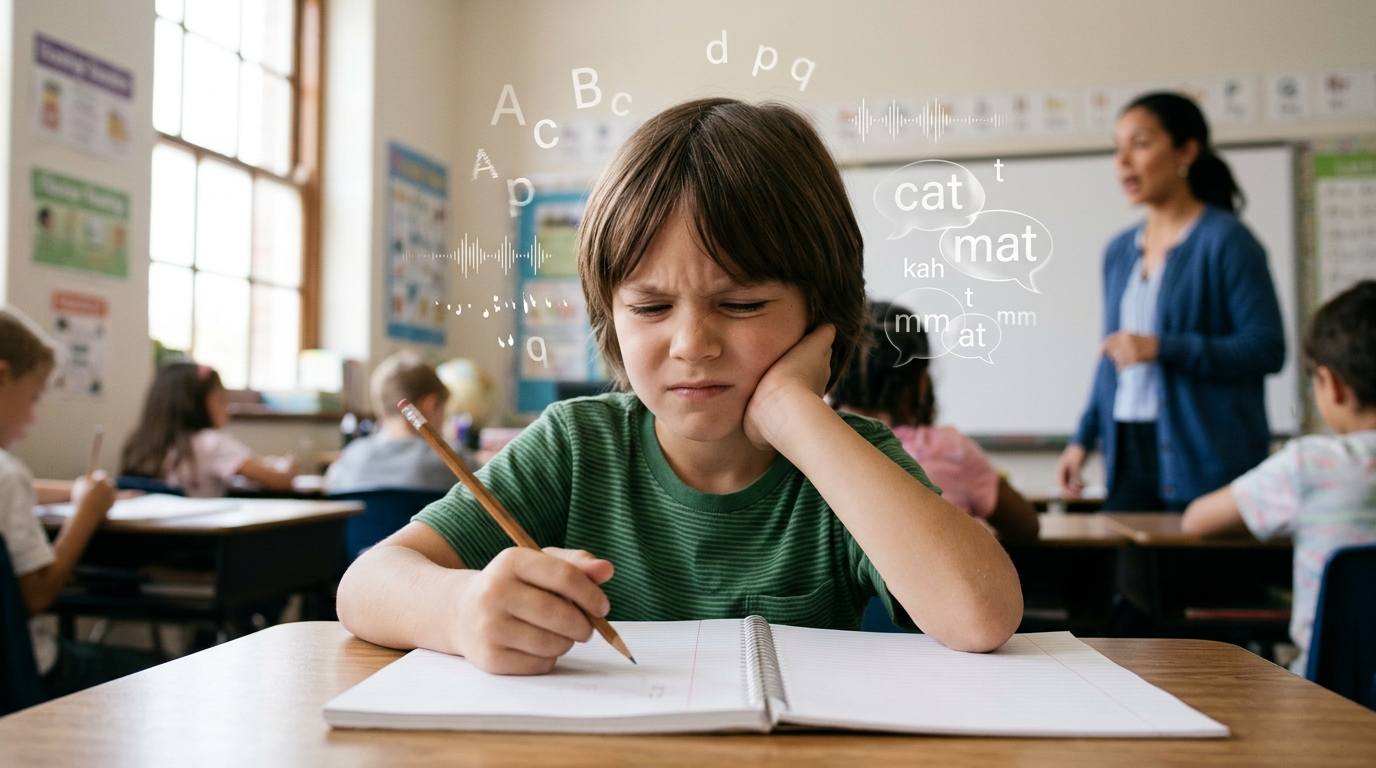
Auditory Processing Disorder (APD), or Central Auditory Processing Disorder, is a condition where a child has normal hearing but the brain struggles to interpret sounds. Around 3% to 5% of school-aged children experience APD, meaning at least one child in a typical classroom may work twice as hard to follow a simple instruction.
For parents in Dubai, the challenge often shows up first at school. A child with APD may seem distracted, forgetful, or defiant, when their brain is dropping or scrambling spoken information. Speech Therapy can help, but understanding what is happening is the first step.
What APD Looks Like Day to Day
Signs are easy to confuse with attention or behaviour problems, and many children have more than one issue. Recognizing the signs of auditory processing disorder involves looking for common patterns, including:
- Trouble understanding speech in noisy places like classrooms, play areas, or restaurants
- Mishearing similar-sounding words or missing small parts of sentences
- Difficulty following multi-step verbal instructions, especially when given quickly
- Falling behind in phonics, spelling, or reading despite normal hearing test results
- Missing sarcasm, jokes, or tone of voice, which affects friendships
- Asking for repetition often, or saying “what?” even when the message was clear
These behaviours are not laziness. The auditory system is not delivering a clean signal to the brain’s language centres.
How APD Is Diagnosed
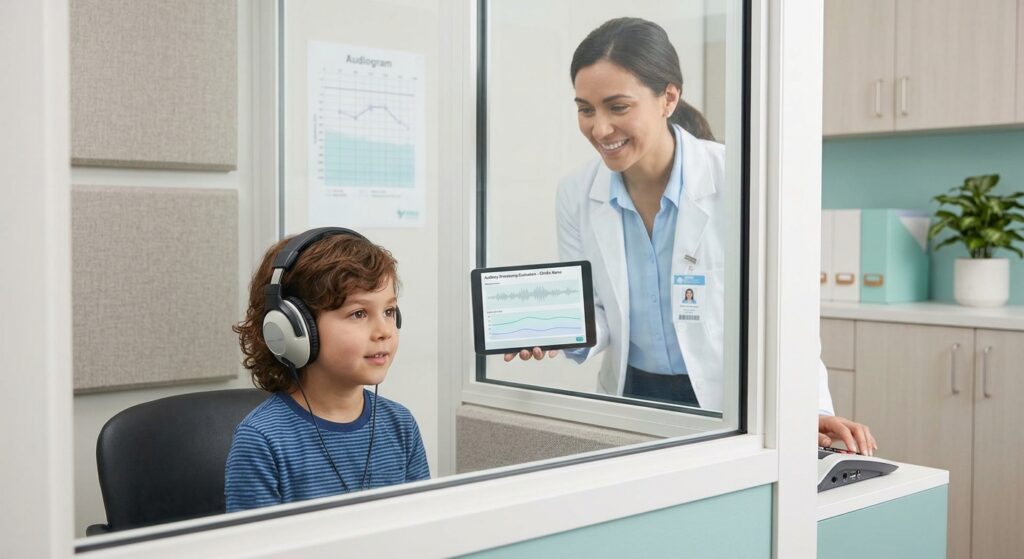
Diagnosis is not made by a paediatrician or teacher alone. A licensed audiologist evaluates and diagnoses APD, typically once a child is around 7 years or older. Before that, auditory pathways are still maturing, making formal testing unreliable.
Assessment usually happens in a sound booth and measures specific skills:
| Skill Tested | What It Shows |
|---|---|
| Auditory figure-ground | Understanding speech when background noise is present |
| Dichotic listening | Processing different sounds presented to each ear at the same time |
| Temporal processing | Detecting small gaps and order in sounds |
| Binaural interaction | How well both ears work together |
Because APD often overlaps with ADHD, dyslexia, or language delays, a multidisciplinary review matters. In Dubai, parents can seek clinical psychology assessments alongside audiology testing to build a complete picture of how a child learns and processes information.
Causes and Related Conditions
The exact cause is not always clear. Family history, prenatal factors, traumatic brain injury, and chronic ear infections in early childhood can all play a role. APD is more common in boys than girls.
APD frequently co-occurs with other conditions. A child may have speech sound disorders in children alongside APD, or mixed receptive expressive language disorder, where understanding and producing language are both affected. Some children with ADHD in children symptoms and treatment overlap with APD, which is why careful assessment matters before labelling a child as inattentive.
Practical Support at Home and School
Parents in Dubai can start helping before a formal diagnosis. Strategies are simple and cost nothing.
Reduce background noise during homework and conversations. Turn off the television, close the door, and face the child when speaking. Gain attention first by saying their name and waiting for eye contact before giving instructions.
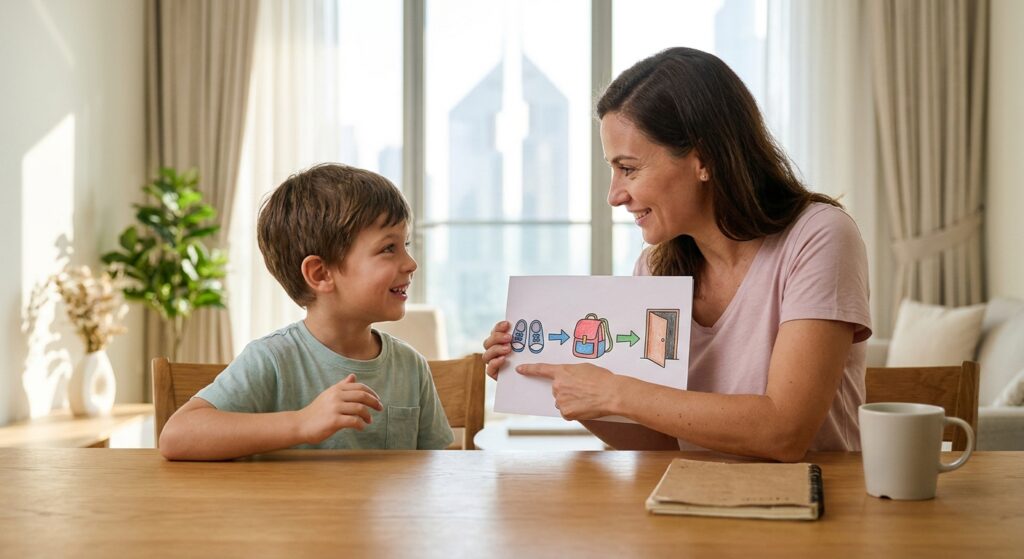
Break instructions into smaller chunks. When facing a child not understanding verbal instructions, avoid giving multi-step tasks like “put your shoes on, get your bag, and wait by the door.” Instead, give one step at a time. Use visual supports like checklists or pictures, especially for routines.
At school, ask for preferential seating away from heaters, air conditioning units, windows, or doorways. Many Dubai classrooms have hard surfaces and constant background hum from AC systems, making listening harder for a child with APD. A quiet corner or a buddy who repeats instructions can make a real difference.
Home Exercises That Build Auditory Skills
Parents can practise simple listening games at home. Play a game where the child closes their eyes and identifies a sound, like a tap running, a spoon stirring, or a door closing. Read a short story and ask one specific question about a detail, then gradually increase to two questions.
Another useful exercise is sound blending. Say the sounds of a word separately, like “c-a-t,” and ask the child to blend them into the whole word. This builds the phonological awareness that APD often weakens.
For children who also show signs of sensory overload in children, occupational therapy services may help with broader sensory regulation and addressing auditory processing difficulties in children. The key is consistency: ten minutes a day works better than an hour once a week.
When to Seek Professional Help
If a child shows several signs of APD for more than a few months, especially after age 5, a professional evaluation is worth pursuing. Start with a hearing test to rule out hearing loss, then consult an audiologist experienced in APD testing.
Bridgescaredubai offers support for children with listening and language difficulties, including those where APD overlaps with speech or attention challenges. The team can also guide parents on the difference between speech delay and language delay, which matters because APD affects language processing rather than speech production alone.
Parents often ask about how excessive screen time affects children’s communication. While screen time does not cause APD, heavy passive screen use can reduce the rich, back-and-forth conversations that help children build auditory attention. Limiting background media during play and conversation is one of the simplest protective steps.
Common Mistakes to Avoid
One common mistake is waiting too long. APD is not something children simply outgrow, and the academic gap widens each year. Another mistake is treating APD as a behaviour problem. Punishing a child for not listening when their brain is not processing the message creates anxiety and shame.
A third mistake is relying on one professional alone. APD sits at the intersection of audiology, speech-language pathology, and sometimes psychology. A coordinated approach gives the clearest picture.
FAQs
1. What type of hearing aid is best for people with auditory processing disorder?
Hearing aids are not the first-line treatment for APD. Some children benefit from remote microphone systems, where a teacher wears a small microphone and the child wears a receiver that delivers the voice directly to their ears. This reduces background noise without amplifying all sounds. An audiologist can advise whether this is appropriate.
2. What are some free auditory training programs?
Free options include listening games at home, audiobook follow-along activities, and apps that target sound discrimination. Some audiology clinics also provide home exercise sheets. The quality of practice matters more than the tool itself.
3. How to improve auditory processing in adults?
Adults can use similar strategies: reducing background noise, asking for written summaries, and practising active listening. Some adults benefit from formal auditory training programs delivered by audiologists or speech-language pathologists.
4. What are some good apps for auditory processing disorder training?
Apps that focus on phonological awareness, sound discrimination, and memory for spoken sequences can help. Look for apps designed by speech-language professionals rather than general games. A therapist can recommend options suited to the child’s specific profile.
If your child struggles to follow conversations, seems lost in noisy rooms, or is falling behind in reading and spelling, an evaluation can bring clarity. Book a consultation with Bridgescaredubai to discuss your child’s listening and communication needs.