

A learning difficulty is a broad term for any obstacle that slows a child’s academic progress, often temporary and responsive to targeted teaching. A learning disability is a lifelong, brain-based condition that affects specific skills like reading, writing, or maths despite average or above-average intelligence. The distinction matters because it changes the support a child needs, the language professionals use, and the expectations parents should hold.
In Dubai, families often encounter both terms when seeking help through schools, clinics, or services such as Clinical Psychology Services. Understanding which applies to your child is the first step toward getting the right intervention without unnecessary delay or misdirected effort.
How the Two Terms Actually Differ
The confusion is understandable. In the UK and much of Europe, “learning disability” often means an intellectual disability, while “learning difficulty” covers conditions like dyslexia. In the US and increasingly in Dubai’s international school system, “specific learning disability” is the formal term used in special education law for conditions like dyslexia, dysgraphia, and dyscalculia. Meanwhile, “learning difficulty” is used more loosely for any academic struggle.
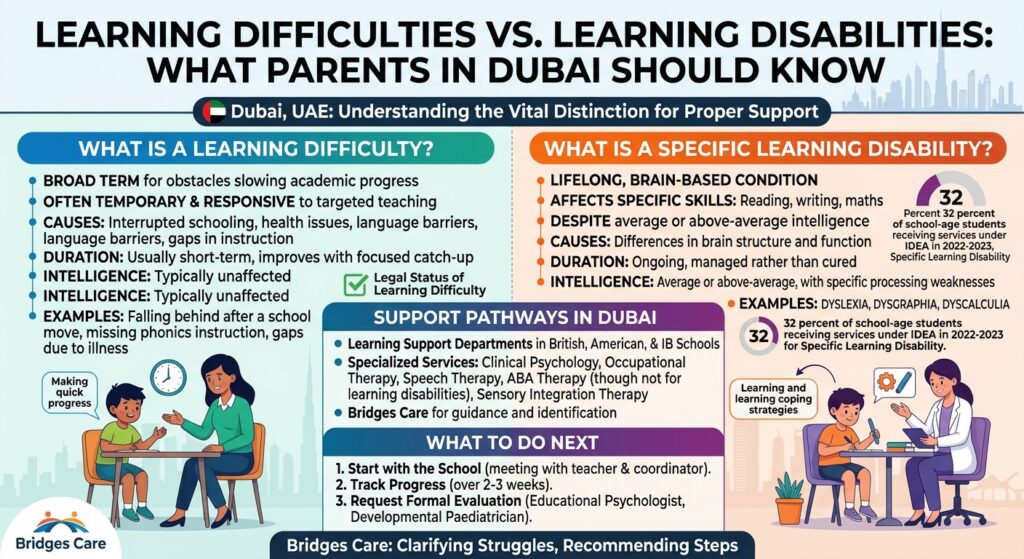
Here is the practical distinction:
| Factor | Learning Difficulty | Learning Disability |
|---|---|---|
| Cause | Interrupted schooling, health issues, absence, language barriers, or gaps in instruction | Differences in brain structure and function |
| Duration | Often temporary; improves with targeted support | Lifelong; managed rather than cured |
| Intelligence | Typically unaffected | Average or above average, with specific processing weaknesses |
| Examples | Falling behind after a school move, gaps from illness, weak foundation in phonics | Dyslexia, dysgraphia, dyscalculia |
| Legal status in schools | Usually no formal diagnosis or special education plan | Recognised under special education frameworks and requires formal evaluation |
What a Learning Difficulty Looks Like
A child with a learning difficulty is often well behind peers in one or more areas but responds quickly once the underlying cause is addressed. Common triggers include a history of interrupted learning, prolonged absence, or health problems that kept the child out of school. The Victorian education guidance notes that with extra support and targeted instruction, these children are likely to improve quickly.
Signs can include negative self-talk about school, reluctance to do homework, frustration during tasks, or anxiety before the school day. These behaviours reflect how the child views their own ability, not laziness. A child who missed key phonics instruction in Year 2 may struggle with reading in Year 4, but structured catch-up often closes the gap within weeks or months.
What a Specific Learning Disability Actually Is
A specific learning disability is a brain-based disorder affecting the ability to read, write, or do maths. In the US, the Individuals with Disabilities Education Act (IDEA) recognises three main types: dyslexia, dysgraphia, and dyscalculia. Of all school-age students receiving disability services under IDEA in the 2022-2023 academic year, 32 percent received services for a specific learning disability as the primary disability, according to the National Center for Learning Disabilities.
These conditions are lifelong learning disabilities in children. A child with dyslexia does not outgrow it; they learn strategies to read accurately and efficiently. The same applies to dysgraphia, which affects writing, and dyscalculia, which affects number sense and arithmetic. Even with excellent teaching, the difficulty persists, which is why formal identification and ongoing accommodations matter.
Why the Distinction Changes What You Do
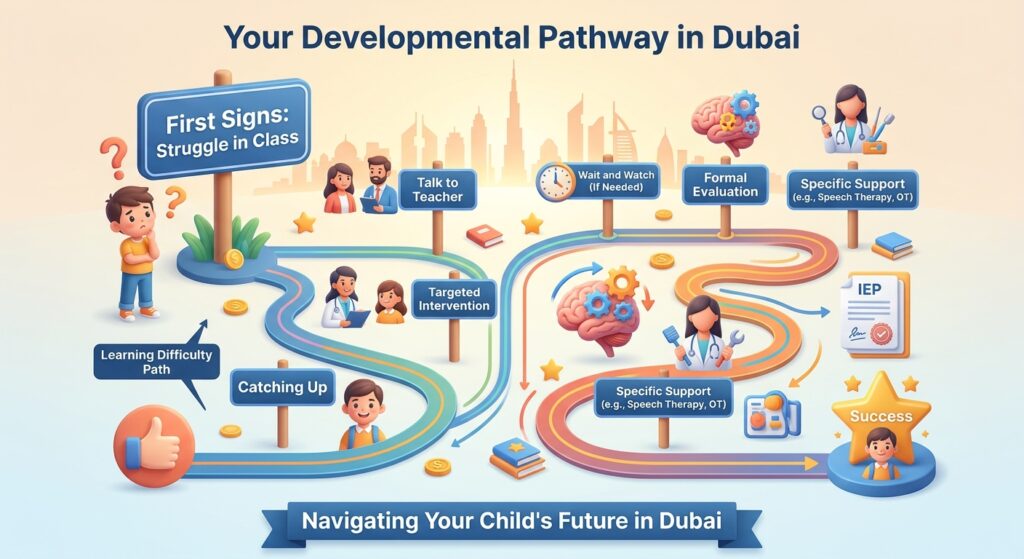
If the issue is a learning difficulty, the first move is often straightforward: speak with the teacher, identify the gap, and discover how to help children with learning difficulties through focused catch-up instruction. Progress should be visible within a few weeks. If it is not, or if the child has always struggled in a specific area despite good attendance and teaching, a learning disability evaluation becomes more relevant.
A common mistake is waiting too long. Parents sometimes assume a child will “grow out of” reading or writing problems. With a true learning disability, that rarely happens without structured intervention. Another mistake is treating every academic struggle as a disability, which can lead to unnecessary labelling and missed opportunities to address simpler causes first.
Support Pathways in Dubai
Dubai’s private school system is diverse, and practices vary between British, American, IB, and other curricula. Many schools have learning support departments, but the quality and terminology differ. Parents should ask directly whether the school distinguishes between learning difficulties in children and specific learning disabilities, and what evaluation process they follow.
For children whose difficulties extend beyond academics, such as attention, motor coordination, or language, additional support may help. Families sometimes explore Occupational Therapy Services for handwriting or coordination issues, Speech Therapy Services for language-based reading problems, or Group Therapy Programmes for social skills. For children with significant behavioural or developmental concerns, ABA Therapy Services may be relevant, though it is not a treatment for learning disabilities themselves.
Specific concerns often surface alongside learning issues. Parents may notice occupational therapy for child concentration problems helps a child stay seated and focused. Others seek guidance on ADHD symptoms and treatment in children when attention difficulties interfere with learning. Some children develop anxiety around schoolwork, and understanding how ADHD can cause anxiety in children clarifies whether emotional struggles are primary or secondary. Parents also ask whether ADHD is a disability or mental illness, since this affects how schools and insurers respond.
Motor coordination difficulties can affect writing and classroom participation. Learning how dyspraxia in children affects daily activities helps distinguish a motor-based problem from a learning disability. Sensory integration therapy for children may be recommended when a child is easily overwhelmed by classroom noise or movement. Recognising signs of sensory overload in children can explain behaviours that look like inattention or defiance.
Language difficulties often overlap with reading problems. Knowing the difference between speech delay and language delay matters because a child who speaks unclearly but understands language needs different support than one who struggles with comprehension. Mixed receptive expressive language disorder affects both understanding and expression, while speech sound disorders in children involve difficulty producing specific sounds correctly.
What to Do Next
Start with the school. Request a meeting with the class teacher and learning support coordinator, describe the specific signs you have noticed, and ask what the school observes. Track progress over two to three weeks. If the gap does not close, request a formal evaluation. In Dubai, this may involve an educational psychologist, a developmental paediatrician, or a multidisciplinary clinic.
For families unsure where to begin, Bridges Care can help clarify whether a child’s struggles reflect a learning difficulty, a learning disability, or something else entirely, and recommend the appropriate next step.
FAQ
1. What kind of support is available for parents with children with learning disabilities?
Support typically includes school-based accommodations such as extra time, assistive technology, and modified assignments, plus external services like educational therapy, speech and language therapy, and occupational therapy. Parent training programmes and support groups also help families advocate effectively within school systems.
2. What is meant by disability group name?
A disability group name is a category used in education and healthcare systems to classify disabilities for funding, services, and legal protections. Examples include specific learning disability, intellectual disability, speech or language impairment, and autism spectrum disorder. The category determines which services a child is eligible to receive.
3. What are the symptoms and causes of dyslexia, according to the Mayo Clinic?
Dyslexia symptoms include difficulty reading accurately and fluently, slow reading speed, trouble spelling, and problems matching letters to sounds. Causes are neurobiological, involving differences in how the brain processes written and spoken language. It often runs in families and is not related to intelligence or vision problems.
4. What are some important daily living skills for individuals with intellectual disabilities?
Important daily living skills include personal hygiene, meal preparation, money management, using public transport, medication management, and basic household tasks. These skills are typically taught through structured, repetitive instruction and may require ongoing support depending on the level of intellectual disability.